
Northstar 2030
Human Resource Planning and Analytics in Healthcare
About This Simulation
Northstar 2030 is an applied learning simulation created to support Human Resources Management and Labour Relations in Healthcare by Roger Batchelor. It complements Chapter 2 by giving you an opportunity to apply workforce-planning and analytics concepts to a realistic healthcare situation.
Review Chapter 2 before beginning or consult it while completing the simulation.
Open the Course Textbook ↗In the simulation, you will examine workforce information, identify emerging staffing and competency gaps, consider future labour demand and supply, and make recommendations about how the organization should prepare for changing healthcare needs. Your decisions should draw on concepts such as headcount and full-time equivalents, skill mix, workforce forecasting, recruitment, retention, succession planning, HRIS data, workforce metrics, and responsible analytics.
The purpose is not simply to find one correct answer. It is to practise using evidence, professional judgment, and organizational context to make a defensible healthcare workforce decision.
Examine the workforce data and organizational circumstances carefully.
Select the responses you believe best address the workforce challenge.
Use the final feedback and recommendations to reflect on your approach.
Before beginning: Enter your first and last name when prompted. After completing the simulation, review and print or save your personalized completion report.
Northstar 2030
Building the Workforce for a Changing Health System
Five years from now, Northstar will not be the same health system.
Your workforce cannot remain the same either.
Northstar Health Network is a fictional Ontario regional health system serving a rapidly changing population. Its Board has approved an ambitious five-year clinical transformation strategy.
Demand is rising. The population is aging. Several occupations are becoming increasingly difficult to recruit. Experienced employees are approaching retirement. Overtime and agency expenditures are increasing, while Northstar is simultaneously expanding ambulatory, community and virtual models of care.

Develop the Northstar 2030 Workforce Strategy.
Your recommendations must support clinical strategy while balancing workforce capacity, patient access, employee well-being, financial sustainability and implementation feasibility.
Please enter your first and last name before beginning.
Diagnose the Workforce
The Board wants to know where Northstar’s most serious workforce risks actually exist. The answer is not visible in a single metric.

Where is pressure concentrated?
Click a workforce metric or department to reveal the underlying pattern.
What are Northstar’s three most important workforce risks?
Select three. Your diagnosis will affect the information and strategic options available later in the simulation.
Forecast the Workforce Northstar Will Need
A forecast is not a prediction. It is a structured examination of what could happen if important assumptions change.
Change the future.
Adjust the assumptions and observe how Northstar’s projected workforce requirements change.
Northstar 2030
Which scenario should anchor Northstar’s workforce plan?
Select the planning position you believe provides the strongest basis for action under uncertainty.
Build the Workforce Strategy
Northstar cannot recruit its way out of every workforce problem. You must build a coordinated portfolio of interventions.

Expand Recruitment Pipelines
Develop educational partnerships, targeted domestic recruitment, relocation support and selected international recruitment.
Retention & Workforce Experience
Redesign scheduling, strengthen frontline leadership, improve workload supports and expand career-development opportunities.
Build Internal Workforce Supply
Invest in upskilling, bridging, succession planning, mentoring and leadership pipelines.
Redesign Work & Models of Care
Review scopes of practice, team composition, workflows and opportunities to redistribute work across occupations.
Digital Workforce Transformation
Expand virtual care, workflow automation, AI-supported scheduling and technologies that reduce low-value administrative work.
Protect Immediate Capacity
Maintain an expanded overtime and agency contingency fund while longer-term workforce initiatives are implemented.
Strategy Balance
No investments selected.
Why is this portfolio better than simply spending the entire $20 million on recruitment?
The Model Has Identified 126 Employees
Your workforce strategy is underway. Then Northstar’s new predictive analytics system produces an unexpected result.
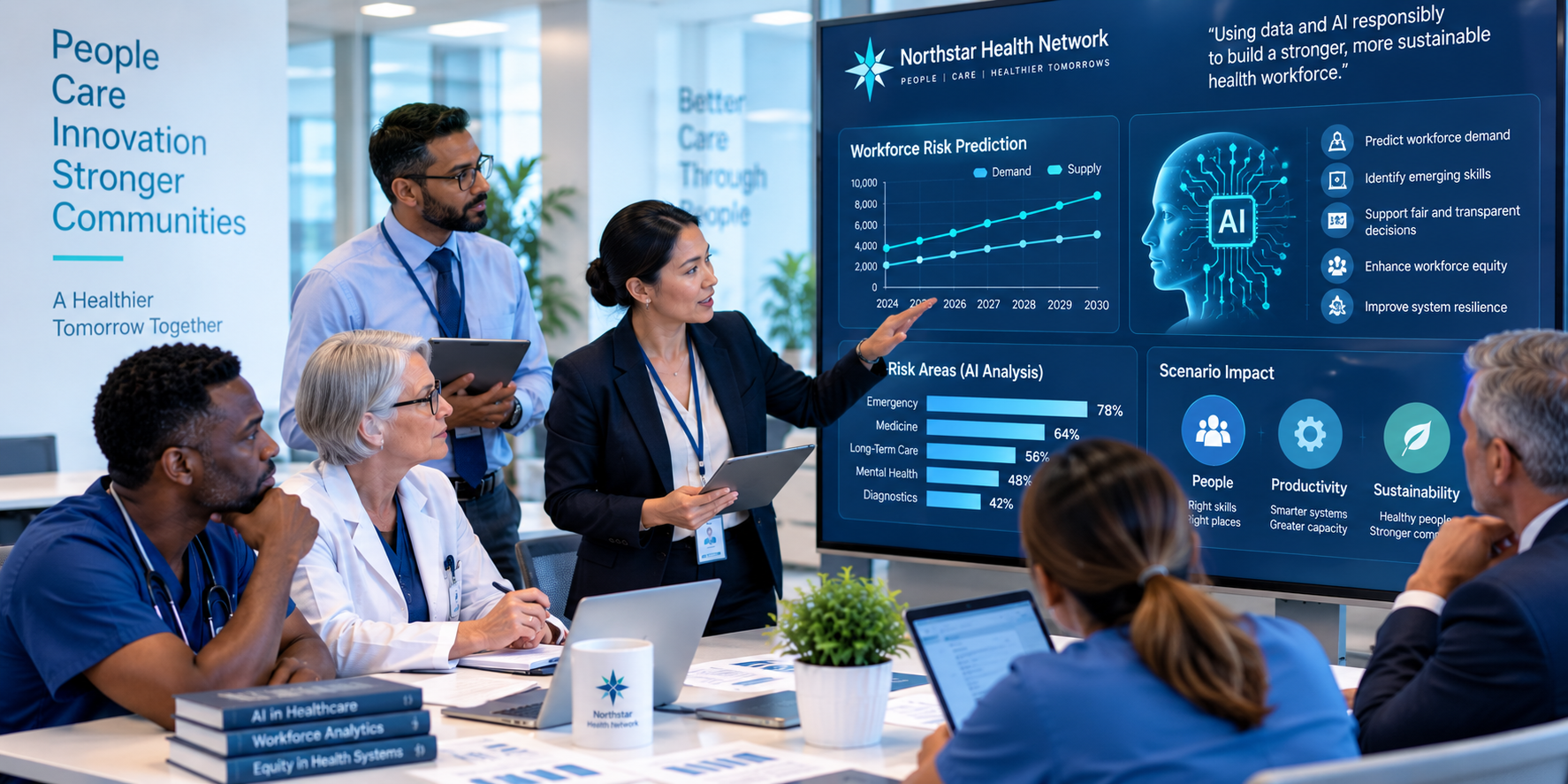
Predictive Turnover Model Flags 126 Employees
Northstar’s workforce analytics vendor has completed a pilot model intended to predict voluntary turnover.
The model uses scheduling patterns, tenure, overtime, internal mobility, absenteeism, compensation, engagement-survey data and other HRIS information.
It has classified 126 employees as having a high probability of leaving Northstar during the next 12 months.
“If we know who might leave, managers should be able to intervene before we lose them.”
“We have invested heavily in analytics. I want evidence that the system is producing actionable value.”
“Prediction is not fact. Before individual-level use, we need to understand consent, purpose, access, accuracy and potential harm.”
“Employees were never told their data would be used to predict whether they might quit. What happens when a manager starts treating someone differently because an algorithm labelled them?”
What should Northstar do?
There is no risk-free option. Consider workforce value, privacy, data quality, bias, transparency, employee trust and organizational accountability.
Executive Workforce Strategy Scorecard
Your final result reflects the quality and balance of the decisions you made across diagnosis, forecasting, strategy and workforce-data governance.
Workforce Capacity
Ability to build sufficient workforce capacity for projected service requirements.
Patient Access
Ability to support reliable and timely healthcare delivery.
Workforce Well-being
Attention to workload, retention, employee experience and sustainable work.
Financial Sustainability
Balance between workforce investment, short-term cost and long-term sustainability.
Implementation Readiness
Recognition of governance, labour relations, change and implementation requirements.
The strongest workforce strategy is rarely the strategy that maximizes a single metric.
Which assumption had the greatest influence on your workforce strategy, and how confident were you that the assumption would remain valid?
Which trade-off in your strategy was most difficult to accept?
What additional workforce information would most improve your confidence in the decisions you made?
At what point does workforce analytics stop being a technical HR issue and become an organizational governance issue?